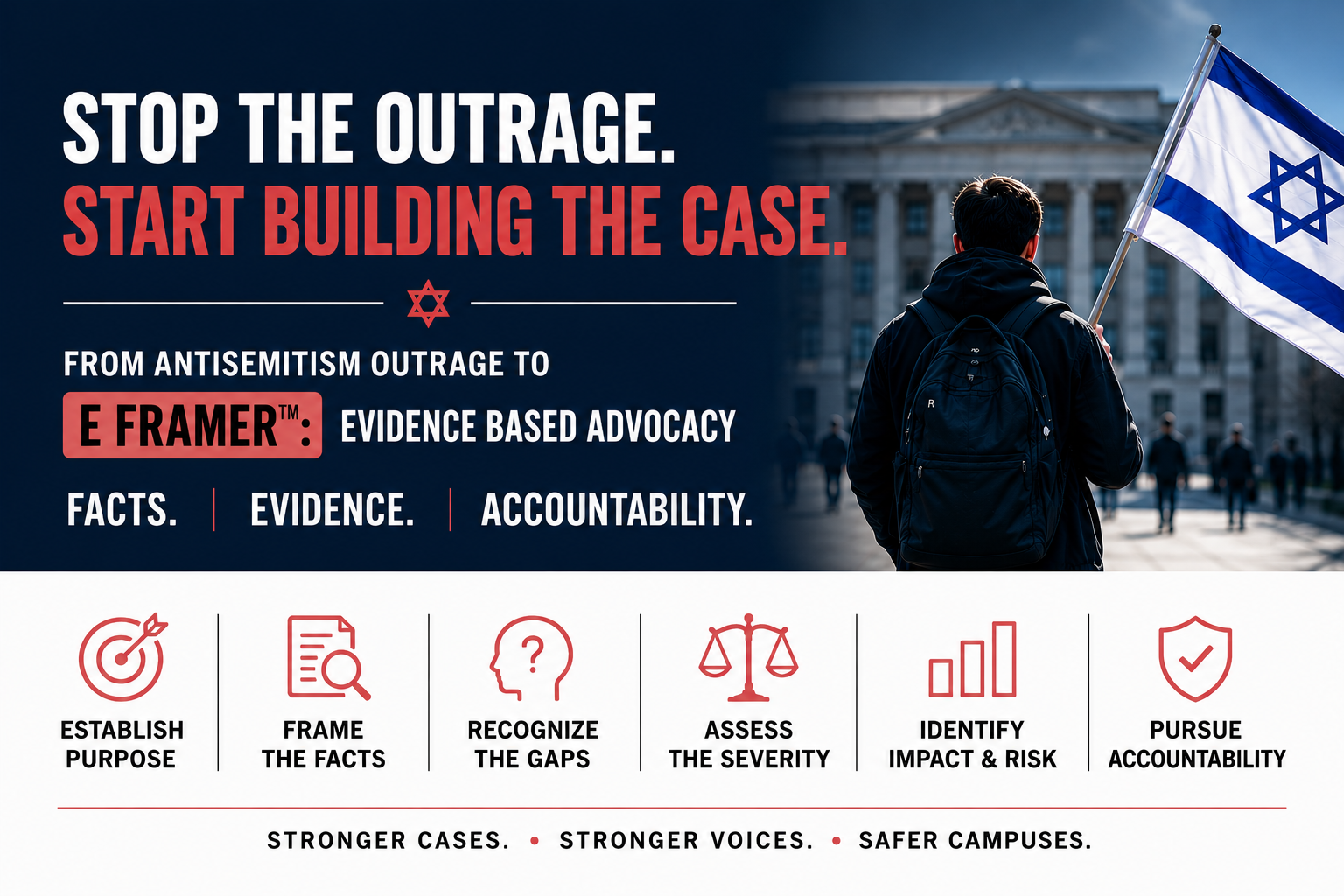

Shift Antisemitism Outrage to E FRAMER™ Accountability Based Advocacy
If we want to protect Jewish students, outrage is not enough. We must understand why cases fail, distinguish protected speech from actionable conduct, and build stronger cases grounded in facts, evidence, and law.
In Jewish Lawyers Are Confusing Our Community About Free Speech, Mark L. Javitch, Esq. (Guest Contributor at Dash of Zion) challenges Jewish organizations and lawyers to examine how antisemitism cases are being built.
He writes:
“The lawyers and organizations backing this appeal are not being straight with our community. Nobody wants to say that a well-regarded organization made an avoidable mistake. But if we misinform people about why we lost and keep filing cases built on offensive speech rather than on conduct, we will keep losing.”
His argument raises an important question:
Are we building the strongest possible cases for Jewish students?
DISTINGUISH SPEECH FROM ACTIONABLE CONDUCT
Fighting antisemitism requires both moral and legal clarity.
Javitch argues that offensive or hateful political speech cannot simply be treated as actionable conduct. A strong case must distinguish protected expression from potentially actionable conduct, including targeted harassment, threats, intimidation, exclusion, discrimination, retaliation, or obstruction.
Recognizing this distinction does not minimize antisemitism. It strengthens our ability to identify and document conduct that may support institutional or legal action.
When those distinctions are blurred, powerful moral claims can become vulnerable legal cases.
COURAGE MUST BE SUPPORTED BY KNOWLEDGE
Javitch makes another important observation:
“Cases do not get brought because organizations file amicus briefs. They get brought because someone comes forward. That takes courage, and it takes knowing the law is on your side.”
So where can our resources have the greatest impact?
We should help students recognize potentially actionable conduct, document incidents, preserve evidence, understand institutional policies and legal protections, and know when to seek qualified legal counsel.
Courage supported by knowledge, preparation, and evidence becomes more effective advocacy.
FROM REACTION TO E FRAMER™
This is where the Let’s Speak Up™ E FRAMER™ Responsible Advocacy Tool can help.
Before filing a complaint or escalating a concern, E FRAMER™ provides a simple structure:
E | ESTABLISH PURPOSE
Why are you raising the concern, and what do you seek to accomplish?
F | FRAME THE FACTS
Document the context, evidence, and sequence of events.
R | RECOGNIZE KNOWN & UNKNOWN
Separate established facts from assumptions, gaps, and information requiring verification.
A | ADDRESS THE DISPARITIES
Compare what occurred with what applicable policies, codes, responsibilities, or laws require.
M | MAP IMPACT & SEVERITY
Document the impact, seriousness, frequency, and pattern of the conduct.
E | ENCLOSE REMEDIES
Propose reasonable and proportional corrective actions.
R | REQUEST FEEDBACK
Request answers, corrective action, and follow up within a reasonable timeframe.
Purpose → Facts → Gaps → Disparities → Impact → Remedies → Feedback
E FRAMER™ does not determine whether a law has been violated. It helps organize the facts, evidence, concerns, and remedies needed to evaluate a complaint and determine the appropriate next step.
FACTS BEFORE CONCLUSIONS
Effective advocacy begins by separating what we believe happened from what we can establish happened.
What happened? What can we prove? What remains unknown? What policies, codes, or laws may apply? What was the impact? What remedy is appropriate?
Recording the facts and receiving a response from administrators also creates an important record. Their response, or failure to respond, can provide additional information about how the institution understood and addressed the concern.
A documented pattern can reveal what a single incident cannot.
LEARN FROM THE CASES WE LOSE
We should not be afraid to examine why a case failed.
Sometimes the law may need reform. Other times, the weakness may lie in the evidence, pleadings, legal theory, characterization of the conduct, or connection between the facts and the applicable legal standard.
We need the courage to distinguish between them.
If we expect universities to examine their failures honestly, advocacy organizations should be willing to examine their own strategies with the same rigor.
Accountability must apply not only to the institutions we challenge, but also to how we advocate. At all times, we must communicate professionally, assertively, and responsibly.
BUILD STRONGER CASES, NOT JUST LOUDER ONES
Jewish students confronting antisemitism deserve knowledge of their rights, tools to document misconduct, help distinguishing protected speech from potentially actionable conduct, and advocates willing to assess both the strengths and weaknesses of their claims.
When facts and evidence support action, they deserve organizations and lawyers prepared to stand behind them.
Javitch reminds us:
“That takes courage, and it takes knowing the law is on your side.”
The question is not simply: How loudly can we fight?
The better question is: How effectively can we build the case?
Build stronger cases. Advocate responsibly. Protect students. Demand accountability.
E FRAMER™ | A Let’s Speak Up™ Responsible Advocacy Tool
Source: Jewish Lawyers Are Confusing Our Community About Free Speech
By Mark L. Javitch, Esq. (Guest Contributor), Dash of Zion