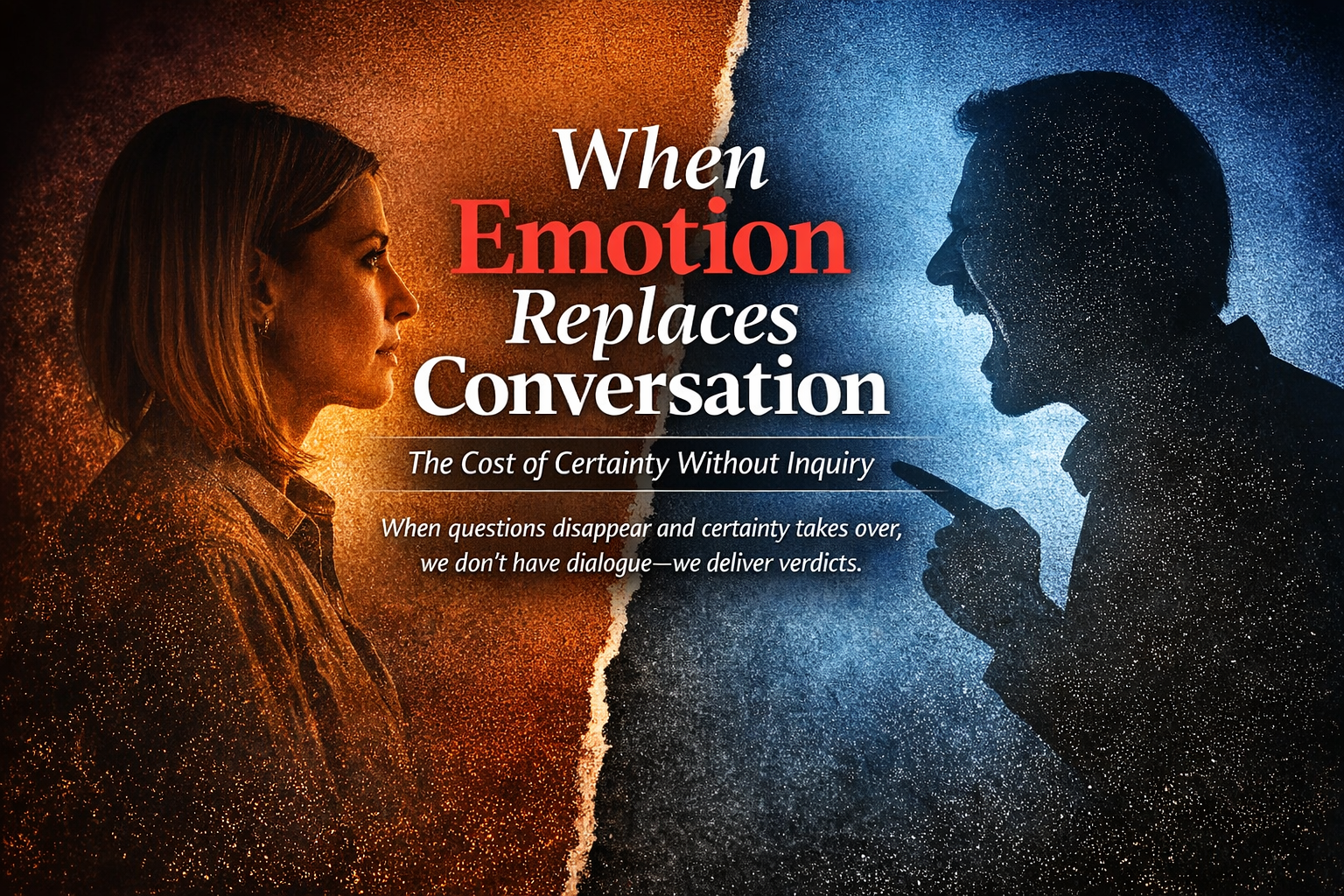

Why conversations are collapsing—and how responsibility, not reaction, restores them
Yesterday, I shared a message from a “friend” ending her connection with me. Not a close friend—someone I had spoken to maybe three times. But we all experience moments like this.
This dynamic is becoming increasingly common.
I wanted to use this as a learning opportunity because I hear about similar situations from clients and friends—and I’ve experienced them myself behind the scenes.
Her message read:
“Lea, I unfriended you on FB and will do the same on Instagram. I look at your page and it sickens me—you support the murder of tens of thousands of innocent Palestinians, even suggesting it’s their own fault. What about the women and children? How can anyone justify that?
As a Christian and a lover of Jesus, I cannot reconcile a connection to you. Netanyahu is a war criminal, and together with Trump, is fueling a war that will kill countless innocent people and affect all of us.
Like many others, I’m done staying silent. I will not be bullied with antisemitic labels for my beliefs or my love for humanity. I wish you well.”
In most cases, we couldn’t care less about Facebook friends. But what happens when it’s someone we truly care about—a close friend or a family member?
In this case, I could have been more compassionate—but this is how I responded:
“First of all, thank you for your honest note. With that, I send you prayers of light, wisdom, and well-being. Who bullied you? Are you projecting or self-inflicting? I really hope you are okay mentally and emotionally.
Your note seems out of alignment with a good Christian or someone who has knowledge of the Gaza-Israel war. I’m sorry for your pain, and I truly did not consider you a friend—especially given how you prejudged my friend before even meeting him. Is that what makes you a good Christian? This is why I do not introduce you to my other friend.
Maybe you should start reading the Christian scriptures again, including the Sermon on the Mount. I also highly recommend you follow CUFI (Christians United for Israel) to better understand your Christianity and the Middle East. Sadly, you have fallen victim to propaganda, and I pray for you. I am grateful for your honesty. Sending you lots of love 🇮🇱🇺🇸”
As expected, she doubled down with a flood of messages:
“Stop, Lea. Stop your passive aggressiveness. It’s exactly what I expected from you. Your response is bullying… I don’t need to read anything—all I need to know is that you support ethnic cleansing… Israel is now the terrorist as well… I need to be honest and not worry about political correctness.”
At that point, I stopped engaging—not because I had nothing to say, but because I realized nothing I said would land. It would only drain energy without creating understanding.
So I chose silence. I chose to preserve my energy. And eventually, I chose to block her.
That moment stayed with me: What outcome did she expect?
🟫 This Isn’t About One Person
This experience is not isolated.
It’s becoming increasingly common—in personal relationships, in public discourse, and across institutions. We are witnessing a shift:
- From inquiry → to insults
- From dialogue → to demonization
- From curiosity → to condemnation
No questions.
No effort to understand.
No desire to learn.
Instead, we see: labels, accusations, and prejudgment.
And often, the one who initiates the attack claims victimhood.
This pattern can reflect internal distress, where unresolved internal tension is projected outward as outrage and accusation.
When inquiry disappears, certainty takes its place.
If we want to heal humanity, we must return to responsibility. As Winston Churchill said, “The price of greatness is responsibility.”
And as reflected across traditions, transformation always begins with the individual. It starts with shifting the “you” to “I”:
- What can I do to be better—and to make the world a better place?
- What can I do to better understand the other person?
At the heart of Jewish tradition is inquiry—the discipline of asking questions, because real learning begins not with certainty, but with curiosity.
🔴 The Contrast That Matters
What stood out to me most is what happened just a day before.
In a separate message, I was asked a simple but powerful question:
“What are your thoughts?” and shared a video.
In essence: Can someone criticize Israel without being antisemitic?
That question created space.
It invited dialogue.
It allowed nuance.
It made learning possible.
And my answer was clear:
Yes—criticism of policy, government, or leadership is part of healthy discourse.
But there is a line. When criticism turns into:
- calling for Jewish genocide
- justifying violence against Jews
- dehumanizing Jews
- calling for the destruction of Israel
This is no longer criticism—it becomes hatred, and perhaps something deeper: a reflection of what lies within.
Pausing and asking questions is the beginning of transformation.
- Is my anger justified—or is it misplaced?
- Who has control over it? Only you.
- What can I do about it? Start by changing something within yourself.
And let me be equally clear:
- There is no moral equivalence between Israel and Hamas.
- There is no moral equivalence between Israel and Iran.
And I ask:
Are you equally outraged by regimes that execute, imprison, and kill their own people?
For those who truly care to learn and discern the difference between antisemitic language and the expression of differing perspectives, I encourage you to review the International Holocaust Remembrance Alliance (IHRA) Working Definition of Antisemitism.
Understanding this distinction is essential.
🟫 Curiosity vs. Conviction
One person asked. Another accused.
One created space. The other closed it.
That difference determines everything.
Curiosity builds connection. Accusations without inquiry break connection.
🔴 Discernment vs. Reaction
We are all influenced—by media, emotion, and the environments we inhabit.
But discernment requires more:
- The discipline to pause and examine details
- The willingness to explore opposing perspectives
- The courage to ask meaningful questions
- The humility to admit we may not have the full picture
Without this, even well-intentioned people act from assumption—not understanding.
If we genuinely care about others, that care must be expressed through thoughtful, assertive engagement—not accusation or condemnation.
Otherwise, we risk creating harm instead of clarity.
We may have limited control over political decisions, but we do have control over how we engage with one another—how we communicate, think, and respond.
And that is where responsibility begins. Ultimately, we must ask:
What is the purpose of this interaction—or this relationship?
And how should I engage to create the best possible outcome?
🔴 My Position
I believe in conversation. I welcome disagreement—in fact, I value it.
I have learned more from those who challenge me than from those who agree with me.
Language matters. Not all of us are taught how to frame our words in a way that leads to the best possible outcomes.
English is my fifth language, shaped by multiple cultural influences—from direct to indirect communication styles. How we frame a conversation determines whether it continues—or collapses.
A simple shift can change everything.
When we use:
- “You” + negative verb → accusation → negative outcomes
- “You” + negative label → condemnation → breakdown of trust
“You” statements often turn into perceived personal attacks—something many people don’t realize.
Instead, shift the language:
- “The issue I see is…”
- “This policy seems to impact…”
- “The situation appears to be…”
Or simply ask:
- “Help me understand how you see this, and how it impacts…”
- “I read this and came across a different perspective—can you help me reconcile the two?”
Because at the core, most of us share the same needs—peace, safety, connection, respect, and the desire to make a difference. What differs is how we believe those needs are met.
🔴 The ONE™ Pause
One of the most powerful tools I’ve developed—and continue to rely on—is simple:
Pause. Before responding, ask:
- Objective: What is the objective of this interaction?
- Need: What need am I trying to fulfill—and why does it matter?
- Expectation: How should I engage to create the best possible outcome?
I call this the ONE™ pause.
It anchors intention.
It guides direction.
It shapes outcomes.
When I use it, conversations move forward.
When I don’t, they escalate.
🟫 Perspective
My perspective is shaped by lived experience. I have lived complexity across cultures and navigated identity challenges.
I seek neither approval nor validation. I seek understanding and learning.
My intent with this post is simple:
To help others recognize the risk of losing something essential—
the ability to have real conversations and meaningful connections, grounded not just in words, but in compassionate action.
🟥 Call to Reflect
Before your next response, pause.
Ask yourself:
- What is the purpose of this interaction?
- How should I engage to achieve the best possible outcome?
Shift from the individual → to the issue.
From reaction → to responsible response.
Because the moment we stop asking, we stop learning.
#CommunicationMatters #Leadership #EmotionalIntelligence #PersonalResponsibility #CriticalThinking #AskQuestions #StayCurious #Dialogue #ONEPause #LeadWithPurpose #LetsSpeakUp #StandAgainstHate