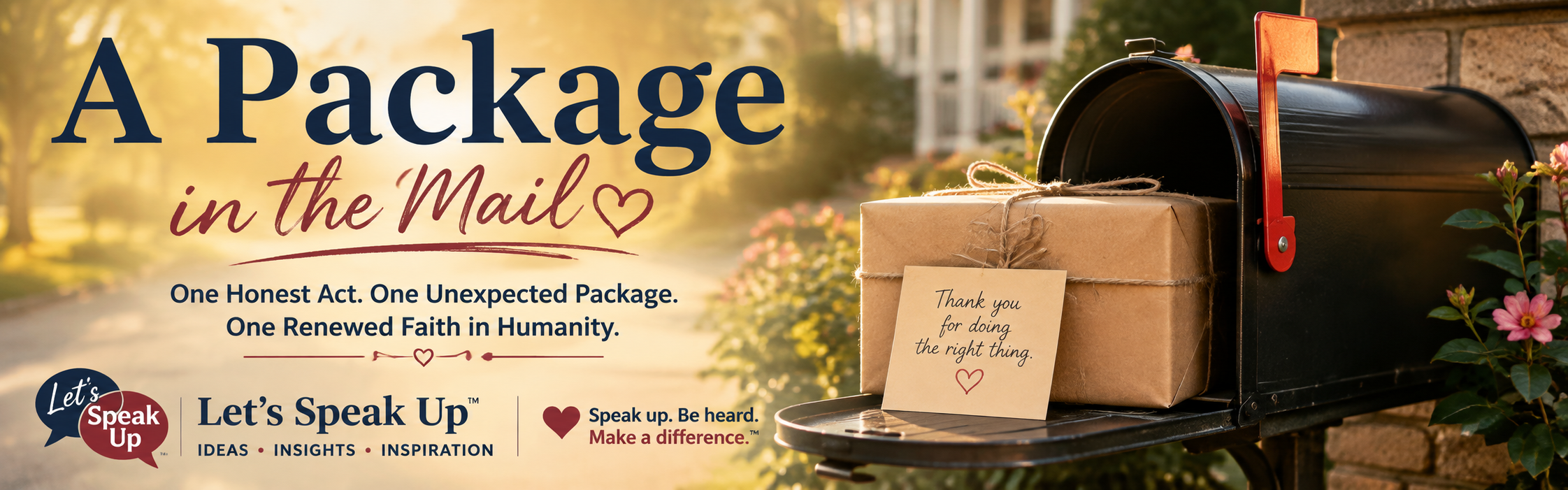

ONE HONEST ACT. ONE UNEXPECTED PACKAGE. ONE ACT TO SPREAD LOVE.
How One Stranger’s Act Created and Can Create a Ripple of Kindness.
Amid a world filled with headlines of conflict, broken relationships, and declining trust, it is often the smallest gestures that leave the greatest impression. A simple question, “Is everything okay?” or “How can I brighten your day?” can transform someone’s day. Acts of kindness rarely make the news, yet they quietly strengthen relationships, restore hope, recharge our energy, and remind us of the goodness that still exists around us.
Consider this situation: What would you do if you found a wallet in a rental car?
Recently, we experienced this extraordinary dilemma.
While traveling with my family abroad, upon checking in to our hotel, I reached for my driver’s license and Global Entry card. My wallet was nowhere to be found.
After searching every suitcase, every pocket, and every compartment, I realized it was gone. We immediately contacted the airline and filed a lost and found report. We also checked our credit card accounts to see whether anyone had used the cards. To our relief, there were no unauthorized charges.
Eventually, we accepted that the wallet was probably gone. We canceled the credit cards, ordered replacements, and even arranged to have new ones shipped to Israel so we could continue our trip. It was inconvenient, but we accepted it as a minor setback in our journey.
AN UNEXPECTED DISCOVERY
Upon returning to the USA, I stayed for another week in Washington, D.C., while my husband returned home to San Diego.
Last week, my phone buzzed with a text message from him.
“Look at these pictures.”
At first, I couldn’t tell what I was looking at. The images were too small to make out on my phone.
“Click on them,” he replied.
As I enlarged the photos, I couldn’t believe what I was seeing.
My wallet had come home.
The photographs showed a padded envelope, a handwritten note, and my wallet with everything still inside.
Almost a month after I had lost it, a woman named Denise rented that same vehicle from Hertz Car Rental. While retrieving one of her own belongings from beneath the driver’s seat, she discovered my phone wallet hidden where no one could easily see it.
At that moment, Denise had several options. She could have left it where it was. She could have handed it to the rental company and trusted someone else to deal with it. She could have walked away believing she had done enough.
Instead, she chose to go out of her way.
My renewed driver’s license from March gave her a clue that this was my current address. She purchased an envelope, paid for the postage herself, and mailed everything back to my home.
Inside the package was a handwritten note explaining how she had found the wallet. She ended her note with a simple sentence that revealed everything about her character.
“Hopefully this will save you stress.”
That sentence stayed with me.
Denise wasn’t thinking about the time she had invested, the postage she had paid, or the inconvenience of mailing the package. She was thinking about the stress she could spare a complete stranger. She understood the frustration of replacing identification, canceling credit cards, and worrying about personal information falling into the wrong hands.
Her concern wasn’t simply returning a wallet.
It was seeing the world from another human being’s perspective and being willing to help.
That is what impressed me most.
THE COST OF GOING OUT OF HER WAY
Returning my wallet required far more than honesty. It required initiative, effort, and generosity. Denise invested her own time, her own money, and her own energy to solve a problem she did not create. She willingly accepted an inconvenience so that someone else could avoid one.
At times, simply seeing the world from another person’s perspective and being solution oriented, regardless of who or what created the problem, is one of life’s greatest lessons.
That is true generosity.
We often admire people for extraordinary accomplishments, public recognition, or professional success. Yet I have come to believe that character is more often revealed in ordinary moments that never make the headlines. It is revealed when someone chooses integrity over convenience, compassion over carelessness, and responsibility over excuses.
Acts like Denise’s rarely receive public attention because they happen quietly. There are no cameras, no applause, and no expectation of recognition. Yet these are the very acts that restore our faith in one another.
Her kindness and thoughtfulness reminded me that society is held together not only by laws and institutions, but by millions of ordinary people who quietly choose to do the right thing when no one is watching.
THE RIPPLE EFFECT OF KINDNESS
We all have opportunities to become Denise or Tony.
Total strangers extending themselves to care for others, despite the uncertainty of the response or reaction.
Small acts of kindness have an extraordinary way of multiplying. One generous decision encourages another. One thoughtful gesture inspires someone else to do the same. That is how trust is rebuilt, one person at a time.
Research supports what many of us intuitively know. Organizational psychologist @Adam Grant, author of Give and Take, argues that generosity inspires more generosity. Likewise, researchers @Nicholas Christakis and @James Fowler have shown that kindness spreads through social networks, influencing not only the people who directly experience it but also those who witness it. Psychologist @Jonathan Haidt describes this phenomenon as moral elevation, the feeling we experience when witnessing an act of goodness that inspires us to become better ourselves.
The opposite is also true. Taking can become contagious. Selfishness can spread. Indifference can spread.
When people repeatedly experience self-interest, dishonesty, or exploitation, trust begins to erode. Others become less willing to help, less willing to give, and more likely to protect themselves first.
Every action creates a ripple. The question is not whether we influence others.
The question is how.
Denise probably never imagined that returning a stranger’s wallet would inspire this article. Yet here I am writing about her kindness, and perhaps tomorrow someone reading this story will choose to help another stranger.
That is how kindness changes the world.
One person. One decision. One ripple at a time.
THANK YOU, DENISE
To Denise,
Thank you for going out of your way.
You probably never imagined that mailing a stranger’s wallet would inspire an article, but your actions reminded me of something our world desperately needs to remember.
You didn’t simply return my wallet. You reminded me that kindness still exists.
You reminded me that character is revealed not in life’s grand moments, but in the quiet decisions we make every day.
You went out of your way for someone you had never met. In doing so, you restored more than my wallet.
Character is not measured by what we accomplish for ourselves. It is measured by what we willingly do for others when there is nothing to gain in return.
Your kindness inspired me and strengthened my belief that integrity, compassion, and generosity still quietly live in the hearts of ordinary people.
YOU CAN TOO SPEAD LOVE.
Please tag someone who has been a Denise or Tony in your life.
I would also like to tag some of my dear friends who are committed to daily acts of goodness: @margertkhan, @orlimoses, @ericanram, and @nicole. I am grateful for your time and your consistent kindness, not only toward me but also for your ongoing commitment to helping others.
You embody the same kindness that Denise and Tony demonstrate every day.
Lead with integrity. Live with purpose. Go out of your way for someone today.
Books and Sources About Generosity
For readers interested in learning more about the science behind generosity, kindness, and how human behavior spreads through social networks, the following books and research provide an excellent starting point.
- Adam Grant, Give and Take: Why Helping Others Drives Our Success (Adam Grant)
- Nicholas Christakis & James Fowler, Connected: The Surprising Power of Our Social Networks and How They Shape Our Lives.
- Jonathan Haidt, The Happiness Hypothesis and his work on Moral Elevation